The Research Triangle in North Carolina has become one of the top destinations in the country for tech engineers, healthcare professionals, and families searching for a better quality of life, which is why deciding between Raleigh vs Durham is the first real question every newcomer faces. These two cities sit only 25 miles apart and share the same economic engine, yet they offer very different lifestyles, price points, and daily rhythms.

The Vibe and Culture: Oak City vs. Bull City
The character of a city shapes your weekends, your friendships, and how quickly a new place starts to feel like home. That is why most people lean toward one Triangle city over the other long before they compare mortgage rates or commute times. Both cities are welcoming and easy to settle into, but they attract different personalities.
Raleigh: The Suburban Oasis
As the capital of North Carolina, Raleigh has a polished, stable, and traditional feel. Locals call it the City of Oaks for good reason, since its wide streets are lined with tall, mature trees that give whole neighborhoods a green canopy in the summer.
Raleigh is deeply family-oriented. You will find spacious suburban neighborhoods, clean public parks, and some of the highest-rated public schools in the state. The look of the place blends classic Southern charm with sleek modern development, so a historic district and a brand-new subdivision can sit only a few minutes apart. It is quieter and more spread out than Durham, and it puts comfort, space, and safety first.
A few neighborhoods worth knowing before you start house hunting:
- North Hills: upscale and modern, often described as Raleigh’s midtown, with shopping and dining within walking distance of home.
- Historic Oakwood: charming and walkable, full of beautifully restored 19th-century houses close to downtown.
- Brier Creek: convenient and practical, with newer homes and quick access to the Research Triangle Park.
The overall vibe is relaxed, polished, family-first, and dependable. If your priority is a yard, good schools, and a calm street to raise kids on, Raleigh will feel like a natural fit.
Durham: Creative and Innovative Energy
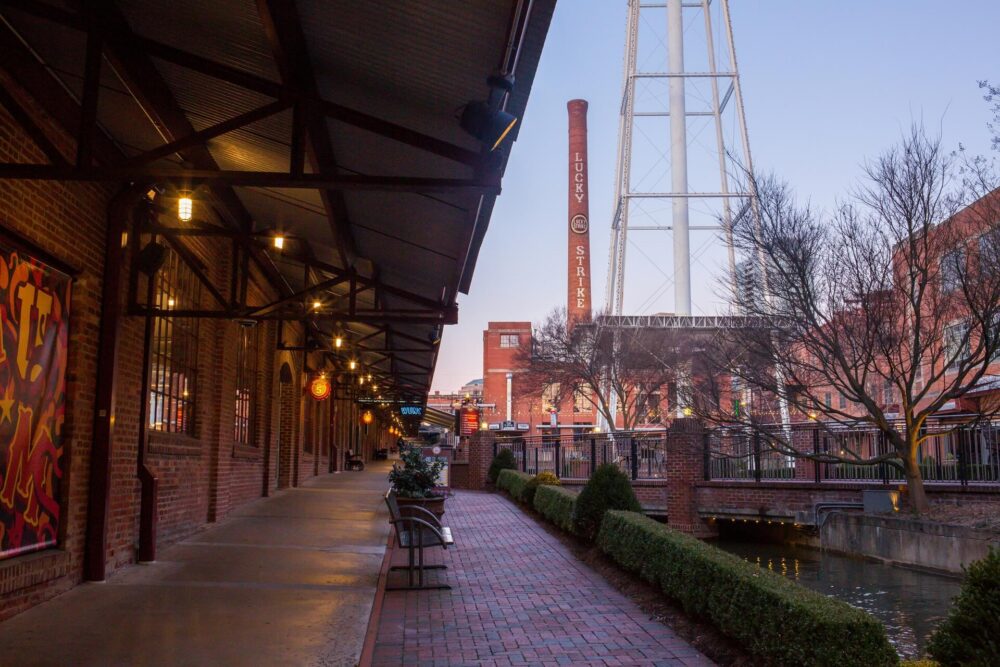
If Raleigh is the well-behaved older sibling, Durham is the creative one with a bit of an edge. Over the past decade the city has gone through a real urban renaissance. It has turned abandoned 19th-century tobacco warehouses into loft apartments, startup offices, and busy craft breweries, all while keeping its industrial character intact rather than paving over it.
Home to the prestigious Duke University, Durham carries an intellectual, diverse, and youthful energy. It has also earned a reputation as the culinary capital of the region, packed with James Beard-nominated chefs, independent coffee shops, and walkable entertainment districts like the American Tobacco Campus. Evenings here tend to happen on foot, moving between a brewery, a restaurant, and a live music venue in the same few blocks.
Neighborhoods worth exploring in Durham:
- Trinity Park: historic, leafy, and a short walk from downtown.
- Hope Valley: established and upscale, with a classic country-club feel and mature landscaping.
- Downtown Durham: walkable and energetic, full of converted lofts and a strong food scene.
The overall vibe is entrepreneurial, diverse, and culturally rich. If you want a shorter walk to dinner, a startup culture, and a city that feels genuinely creative, Durham is hard to beat.
Jobs and the Economy: Anchored by the Research Triangle Park
Both cities open the door to the Research Triangle Park (RTP), the largest research park in the United States. It spans 7,000 acres and is home to hundreds of companies, including major campuses for Apple, Google, IBM, and Cisco. Wherever you land, you are within a short drive of that concentration of jobs, which is a big part of why the region keeps growing so quickly.
Your specific field, though, might nudge you toward one city over the other:
- Tech and government (Raleigh): As the state capital, Raleigh offers strong job stability in government and public administration. It is also full of software developers, IT engineers, and corporate headquarters, so tech careers have plenty of room to grow.
- Medicine and biotech (Durham): Known nationally as the City of Medicine, Durham is built around the massive Duke University Health System. If you work in medicine, clinical research, or biotech, your professional network almost certainly runs through Durham.
It is worth remembering that the 25-mile gap between the two cities is easy to cross. Plenty of people live in one city and work in the other, so you are not locking yourself out of an employer by choosing a home base you love.
Housing and Cost of Living in the Triangle
Cost of living is where the decision gets practical. As of 2026, the Triangle is no longer the hidden bargain it once was, but it still delivers a much better quality of life and noticeably lower costs than New York, Boston, or the Bay Area. For many people relocating from those markets, the difference in monthly housing alone is enough to change how they live.

Auto Shipping
Are you looking for the best auto shipping company near you? Give Kerb a call, ask for a free quote and book our top-notch car transportation services.

Moving Insurance
Are you in need of extra coverage for your valuable belongings? Kerb offers some of the best moving insurance services!

Packing Services
When the time comes for us to relocate, we seek to find any possible help that will ease the whole process.
Housing Realities
Raleigh tends to run a little pricier for single-family homes. Large families compete hard for four-bedroom houses in the top school districts, so the best listings move fast and often draw multiple offers. What you are paying for is square footage, a yard, and family-friendly amenities close to home.
Durham gives you more variety. You can choose between a historic bungalow, a modern downtown loft, or a newly built townhouse, and everyday expenses often run slightly lower than in Raleigh. The main exception is downtown Durham, where the luxury market has climbed close to Raleigh’s suburban prices. Whichever city you pick, coming in with financing sorted and a clear list of must-haves will save you real stress.
Cost Guide Comparison
| Feature | Raleigh (Oak City) | Durham (Bull City) |
|---|---|---|
| Housing style | Roomy suburbs and large single-family homes | Renovated lofts, historic bungalows, and townhomes |
| Cost of living | Slightly higher, driven by suburban demand | Slightly lower, though downtown runs premium |
| Ideal resident | Tech professionals and families with children | Healthcare workers, creatives, young professionals |
| Dining and nightlife | Growing, but spread across the suburbs | Walkable, concentrated, and foodie-driven |
Everyday Life: What Changes When You Move to the Triangle
If you are relocating from a large Northern or West Coast city, a few things will feel different almost immediately. None of them are difficult to adjust to, and most newcomers say the change of pace is a big part of the appeal.
- A slower pace: Life moves a little more calmly here. Southern hospitality is real, so expect friendly small talk at the grocery store instead of the constant rush of New York or Los Angeles. The focus tends to land on work-life balance rather than the office.
- The weather: Springs and autumns are long, warm, and beautiful. Winters are mild, and the rare snowfall usually shuts the region down for a day. July and August, on the other hand, bring real heat and heavy humidity, so a good air conditioner is a genuine investment.
- Nature close by: You are never far from a greenway or a state park like Umstead Park, and both the Blue Ridge Mountains and the Carolina coast are within easy reach for a weekend trip.

Getting Around: Why You Will Need Your Car
Here is one thing every newcomer should know early: the Research Triangle is built around cars. Unlike Boston, New York, or Chicago, there is no comprehensive subway system tying the suburbs to the downtown cores or to RTP. Public buses exist, but relying on them for a daily commute to a tech or medical campus is rarely practical.
From either Raleigh or Durham, the drive to the Research Triangle Park usually takes 20 to 35 minutes, depending on traffic along Interstate 40 or NC-147. School runs, grocery trips, and weekend hikes all assume you have a vehicle ready to go. In short, your car is not optional here, it is part of daily life.
This is exactly why car shipping to RTP belongs on your moving checklist. Driving your car across the country adds days to your trip, piles on hotel costs, and puts unnecessary wear on the vehicle. Shipping it instead means you can arrive rested and settle in right away, with your car waiting for you.

Moving to the Triangle: Common Routes and What to Expect
Long-distance relocations take real planning, and the Triangle is currently one of the busiest destinations in the country for interstate movers. The most common routes into the region right now look like this:
- New York and New Jersey to North Carolina: leaving high taxes and hard winters behind for better real estate and a milder climate.
- California, Bay Area and LA, to North Carolina: tech workers heading to the East Coast answer to Silicon Valley, keeping strong salaries while cutting their cost of living.
- Chicago and the Midwest to North Carolina: trading freezing winters for year-round outdoor living.
One practical tip carries across all of these routes: interstate moves are heavily regulated, so choose a company that offers transparent, flat-rate pricing. That way you are not caught off guard by a weight-based bill that balloons when the truck finally arrives.

A Modern, Digital-First Move with Kerb
If you are an engineer, a researcher, or an IT professional heading to the Triangle, you are used to efficiency, transparency, and technology in your daily work. There is no reason your moving company should feel like a step backward in time.
Many traditional movers still run on old habits: in-home estimators with clipboards, confusing weight-based quotes, and no visibility once the truck pulls away. Kerb works differently. It is a digital-first moving company built for people who expect technology to handle the logistics, and it lines up neatly with how a move to the Triangle actually works:
- Instant digital quotes: Get a transparent, flat-rate price from an app instead of waiting days for an estimate. What you see is what you pay, with no hidden fees at the end.
- Real-time tracking: Follow your moving truck the same way you track a food delivery or a ride, so you know exactly when your belongings will reach your new Raleigh suburb or Durham loft.
- Packing and add-ons: Short on time between back-to-back meetings? Kerb handles packing and unpacking, giving fragile items and electronics the extra care they need.
- Seamless car shipping: Since you will need your car in the Triangle, Kerb can ship it straight to your new driveway. Fly into RDU airport with a suitcase and let the team handle the heavy lifting and the long drive.
The Bottom Line: Which City Is Right for You?
There is no wrong answer between these two cities, only the one that fits your life best. Choose Raleigh if you want space, top-rated schools, and quiet, family-friendly suburbs, or lean toward Durham if you want a walkable, creative, food-first city with real startup energy. Either way, the shared strength of the Research Triangle means you are never far from great jobs, good food, and easy access to nature.
Whether you are drawn to the calm, family-focused streets of Raleigh or the creative, innovative heartbeat of Durham, you are making a smart choice by moving to the Research Triangle. When you are ready to start, Kerb can make the relocation itself feel as modern and efficient as your new hometown.
FAQ
Is it cheaper to live in Raleigh or Durham?
Overall, Durham is usually a bit more affordable, especially when you look at everyday expenses and property taxes. The main exception is prime downtown Durham real estate, which can rival Raleigh’s suburban prices.
Which city is better for families?
Both cities have wonderful family-friendly pockets, but Raleigh is the traditional favorite. Its wide suburbs, the highly rated Wake County public schools, and its many quiet parks make it a natural fit for growing families.
How far is the commute to the Research Triangle Park?
RTP sits right in the middle of Raleigh, Durham, and Chapel Hill. Depending on your exact neighborhood, the drive from either city typically runs 20 to 35 minutes.
Should I drive my car or use a car shipping service?
If you are moving from the East or West Coast, car shipping is the easier choice. It saves you days of driving, cuts hotel costs, and adds zero mileage to your vehicle. Kerb can bundle your long-distance move and car shipping into one smooth, digital experience.
 Steven Rogers
Apart from sharing Captain America's name, our freelance writer Steven is also a big fan of moving, history, and geography.